RFID Visibility Built for Harsh Oil & Gas Environments
Track assets, tools, equipment and inspection status across upstream, midstream and downstream operations — with rugged tags, reliable readers and connected software.
- ATEX / IECEx Options
- UHF & IoT
- ERP, EAM & CMMS Integration
- Qatar & GCC Project Support

RFID Across the Complete Oil and Gas Value Chain
Replace fragmented labels, manual counts and disconnected spreadsheets with an engineered identification layer that links each physical asset to reliable digital records.
Upstream
Exploration, drilling and extraction
- Drilling equipment
- Pipes and tubular assets
- Field tools
- Lifting gear
- Offshore equipment
- Remote-site inventory
Midstream
Storage, processing, transportation and logistics
- Storage-terminal assets
- Pipe yards
- Containers
- Returnable transport assets
- Warehouse inventory
- Custody and transfer events
Downstream
Refining, supply and distribution
- Refinery equipment
- Valves, flanges and pipelines
- MRO inventory
- Inspection status
- Maintenance history
- Distribution assets
Reliable Identification Where Ordinary Labels Fail
End-to-End Traceability
Create a unique digital identity for every asset and preserve its lifecycle history from receipt and commissioning through inspection, maintenance and retirement.
Hazardous-Area Options
Provide appropriately certified RFID tags, handhelds and readers with ATEX or IECEx options for regulated oil-and-gas environments.
No-Line-of-Sight Reading
Read RFID-tagged assets without requiring direct visual alignment. Support fast identification and bulk asset counting.
Harsh-Environment Durability
Support appropriate tag constructions for:
- Metal surfaces
- Extreme temperatures
- Pressure and impact
- Chemicals and oil
- UV exposure
- Rain and humidity
- Seawater and offshore conditions
Enterprise Integration
Integrate asset events with:
- ERPNext
- SAP
- Oracle
- Microsoft Dynamics
- EAM
- CMMS
- WMS
- Custom industrial platforms
IoT and Active Visibility
Provide active IoT or location technology options when the operation requires live movement, geolocation, alerts, mustering or worker-safety workflows.
Certification, read performance and environmental suitability depend on the selected tag, reader, mounting method, hazardous-area classification and operating conditions. Final equipment selection is subject to technical validation and client HSE approval.
Steel, aluminium, galvanised, plastic & disposable
We supply every category of RFID tag housing to match the asset, environment and budget — from corrosion-proof 316L stainless steel for Oil & Gas flanges to colour-coded plastic and single-use disposable temporary tags for shutdowns.
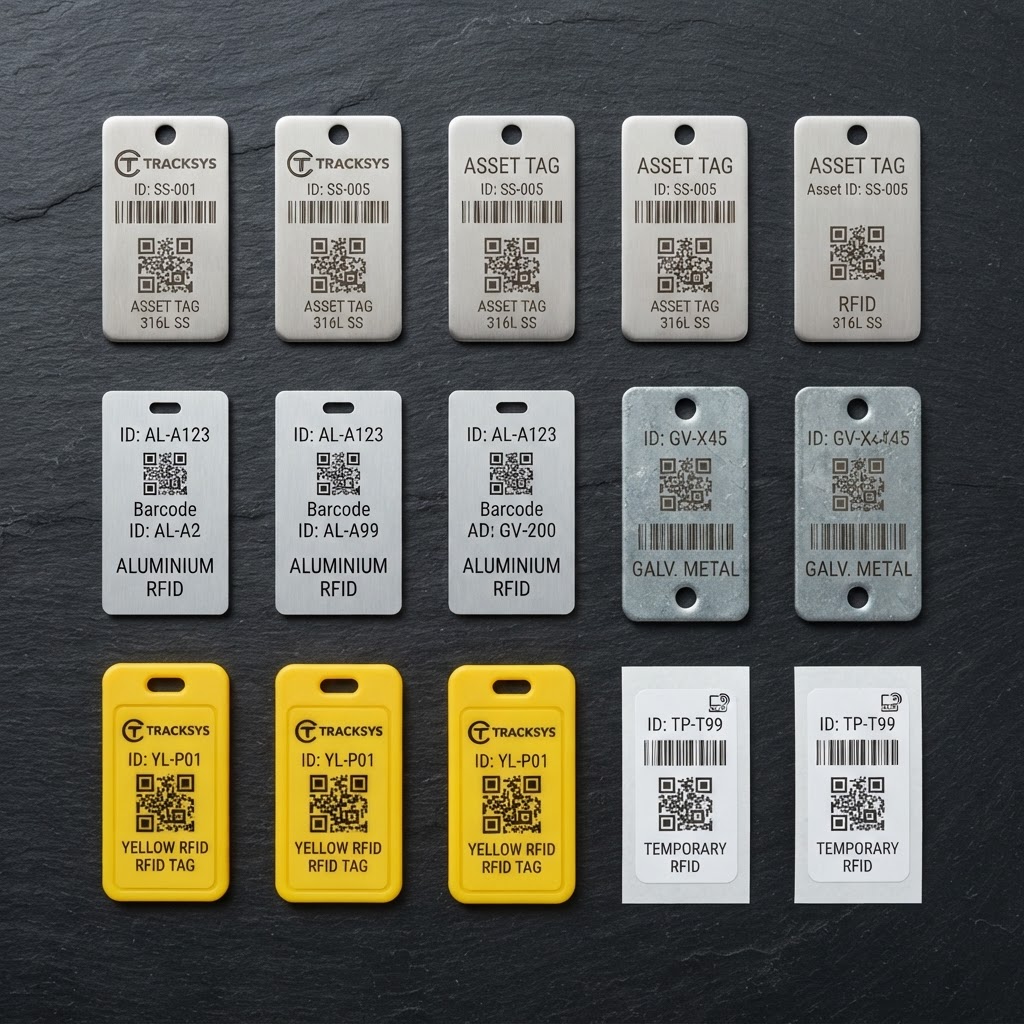
Stainless Steel (316L) RFID Tags
Oil & Gas grade316L stainless steel housings survive corrosion, hydrotesting, H2S exposure and high temperatures. Laser-engraved surface text resists abrasion for the full asset life. The standard choice for flange and valve tagging in refineries, LNG and petrochemical plants.
Aluminium RFID Tags
Lightweight industrialAnodised aluminium tags offer a strong strength-to-weight ratio with laser-engraved permanence. Widely used for structural assets, scaffolding, cable trays and equipment nameplates in manufacturing and construction.
Galvanized Steel RFID Tags
Outdoor durableHot-dip galvanised tags resist weather and impact for outdoor infrastructure — pipelines, fences, street lighting and utility poles where long-term corrosion protection is required.
Plastic / Polymer RFID Tags
EconomicalUV-stable plastic housings in colour-coded options for inspection status, IT assets, tools and indoor equipment. Lightweight, cost-effective and printable for barcode + QR + RFID hybrid encoding.
Disposable / Temporary RFID Tags
Shutdown useSingle-use paper or Tyvek temporary tags for shutdowns and turnarounds — colour-coded stage indicators (broken, assembled, tightened, tested) applied per joint and removed at handover. Replaced by the permanent master tag.
Steel vs Aluminium vs Plastic in a refinery
| Attribute | 316L Stainless Steel | Aluminium | Plastic / Polymer |
|---|---|---|---|
| Corrosion resistance | Excellent — resists H2S, seawater, acids | Good — anodised coating protects against mild corrosion | Good — chemically inert to most refinery fluids |
| Temperature range | -40°C to +250°C | -40°C to +150°C | -20°C to +85°C |
| Impact & abrasion | Very high — laser-engraved, will not wear | Medium — can dent under heavy impact | Low — can crack or fade under abrasion |
| On-metal RFID read | Engineered anti-metal inlay, reliable on flanges | Good on non-steel surfaces; needs spacing on steel | Good off-metal; reduced range on bare steel |
| Lifespan in refinery | 10+ years (permanent master tag) | 5–8 years | 2–4 years (indoor / sheltered assets) |
| Typical IP rating | IP68 / IP69K | IP67 | IP65 |
| Relative cost | Highest | Medium | Lowest |
| Ideal refinery use | Critical flanges, valves & vessels exposed to hydrocarbon, hydrotesting and H2S. | Structural assets, cable trays, scaffolding and equipment nameplates. | Indoor tools, IT assets, inspection-stage colour coding and low-risk inventory. |
Rule of thumb: use 316L steel for every permanent flange and pressure-boundary tag; aluminium where weight matters; plastic for indoor or short-life assets. Add disposable temporary tags for shutdown stages.
Asset visibility across every oil-and-gas workflow
Valves, Flanges and Pipelines
Connect technical records, maintenance history and inspection status directly to the physical asset.
Tools and Maintenance Equipment
Control tool issue, return, availability, calibration and maintenance status.
PPE and Safety Equipment
Manage assignment, inspection validity and availability of critical safety equipment.
Pipe Yards and Offshore Logistics
Track pipes, buoys, containers and other high-value assets across yards, bases and marine operations.
MRO Stores and Inventory
Improve material visibility, inventory accuracy, cycle counting and warehouse-to-worksite movement.
Vehicles and Mobile Assets
Maintain identification, location and maintenance history for vehicles, trailers and mobile machinery.
Calibration and Compliance
Display certification and calibration validity at the point of use and prevent expired equipment from entering operations.
Personnel Safety Workflows
Support mustering, restricted-area monitoring and emergency-alert workflows using appropriate active RFID or IoT technologies.
Tagging solutions across every sector
From oil fields to hospitals — the same RFID backbone adapts to each industry's assets and compliance needs.
RFID Hardware in Harsh Industrial Environments
Rugged tags, handhelds and readers deployed across refineries, pipe yards and offshore facilities in Qatar and the GCC.
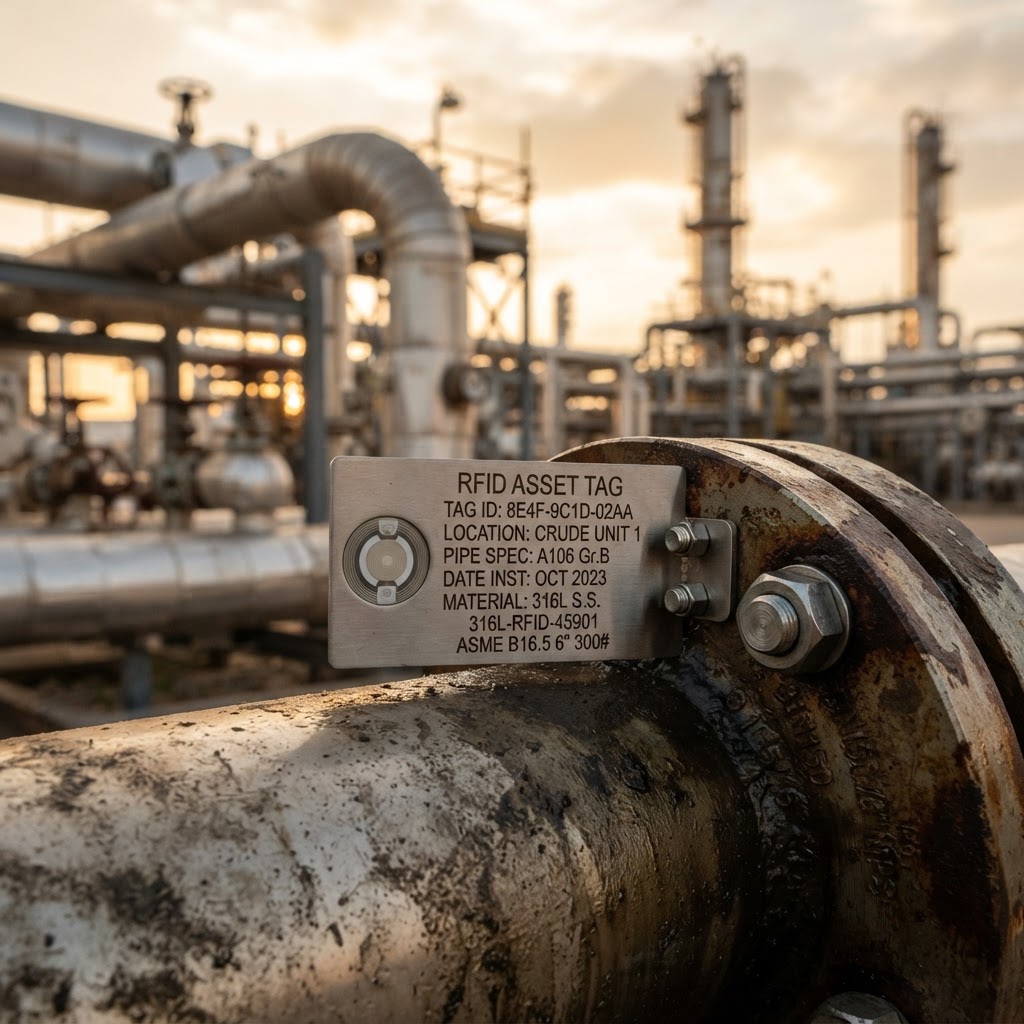
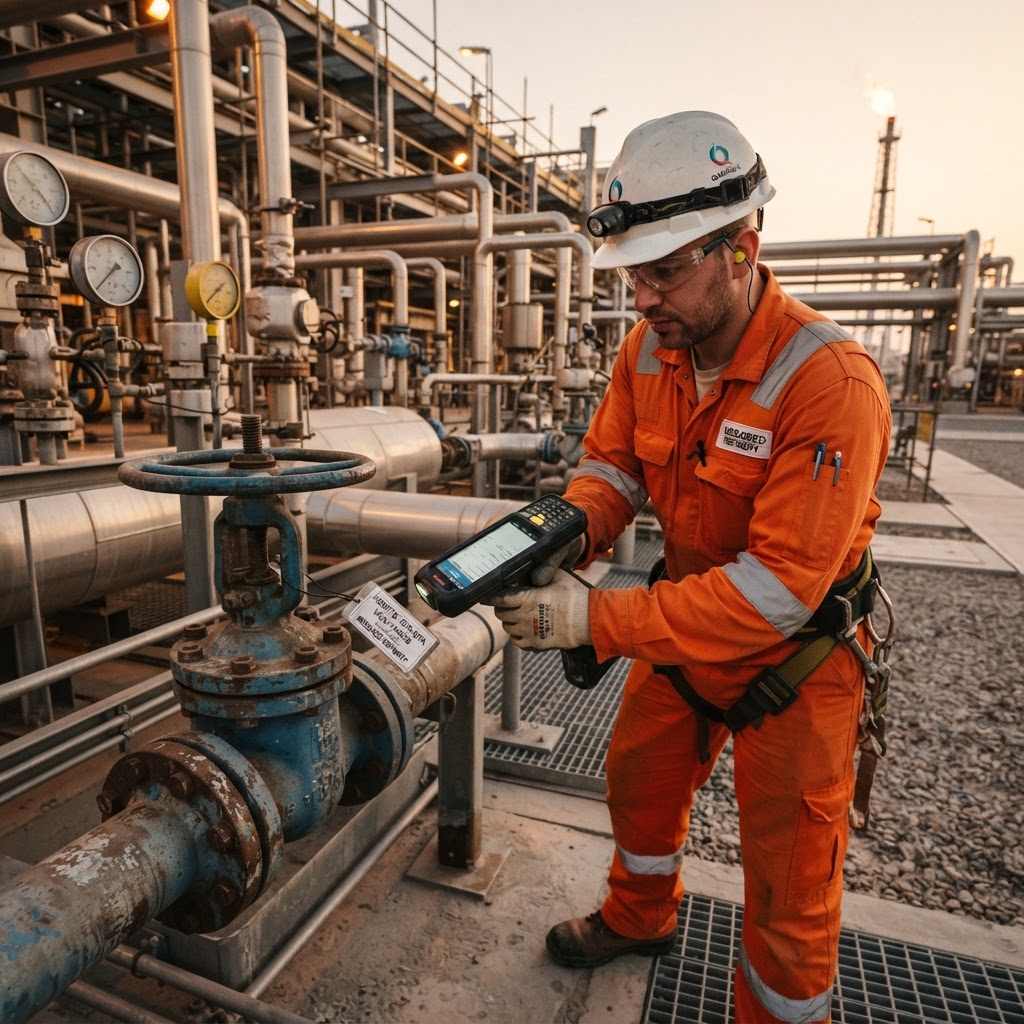
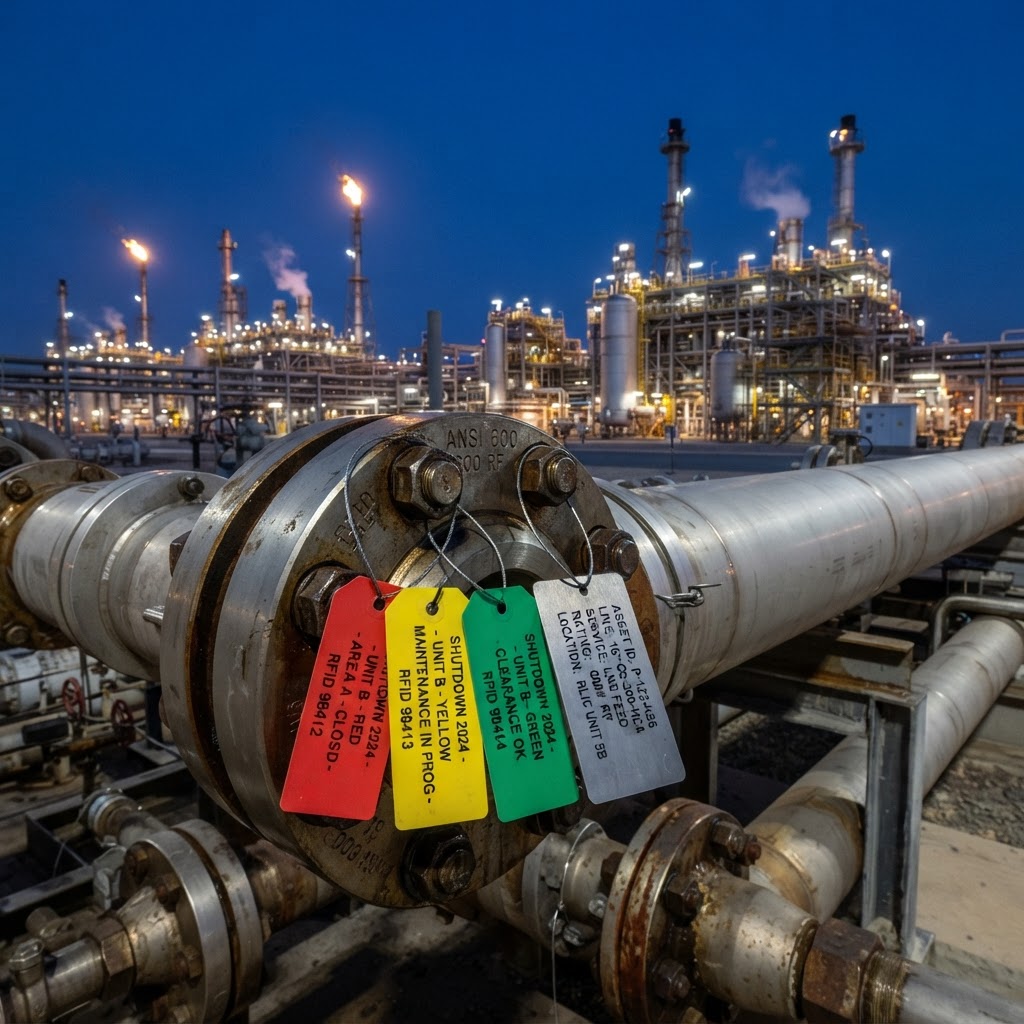
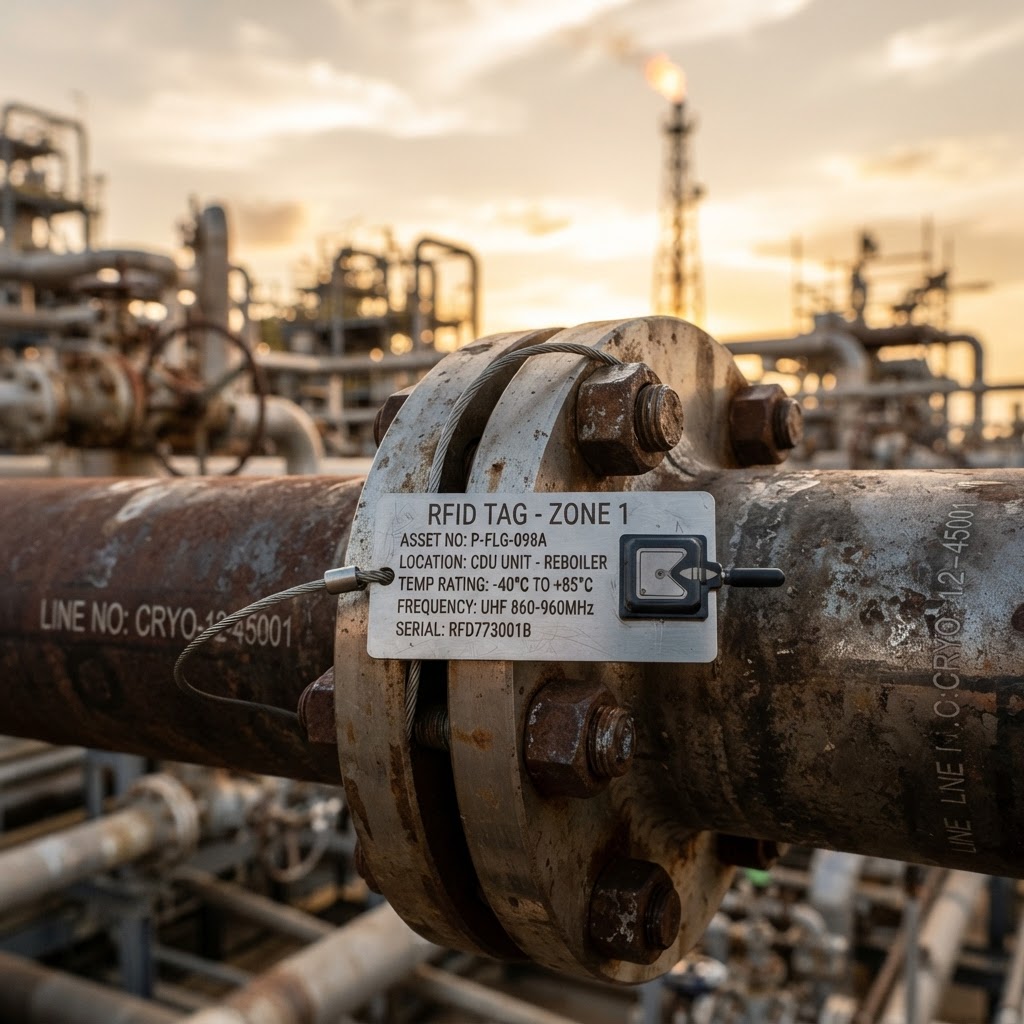
Flange Management & RFID Asset Tagging
A short cinematic overview — from the steel RFID flange tag and field scan to the live joint-integrity dashboard that ties it all together.
Short reference clip of the Flange Track Pro & RFID asset tagging workflow.
A Complete RFID Solution — Not Just a Tag
Rugged RFID Identity
Passive UHF, HF/NFC, on-metal, polymer, stainless-steel and custom tag formats.
Reliable Data Capture
Fixed readers, antennas, mobile computers, rugged handhelds and intrinsically safe device options.
Field Applications
Asset registration, inspection, inventory counting, issue and return, maintenance, photo evidence, offline operation and synchronization.
Enterprise Integration
Dashboards, alerts, reporting and connections to ERP, EAM, CMMS, WMS and custom applications.
RFID Platform — Technical Specifications
Reference specifications across RFID frequency, environmental protection and supported sensor integration for harsh oil-and-gas deployments.
Operating Frequency
| Frequency Band | Typical Read Range | Primary Oil & Gas Use |
|---|---|---|
| LF (125–134 kHz) | Contact / < 10 cm | Access control, short-range asset ID |
| HF / NFC (13.56 MHz) | < 10 cm | Tool crib, small-part ID, mobile scan |
| UHF (860–960 MHz) | 1–6 m (varies) | Asset tracking, inventory counting, gate portals |
| Active / IoT (2.4 GHz / UWB) | 10–100 m+ | Real-time location, mustering, vehicle tracking |
Environmental Protection Ratings
| Rating / Parameter | Typical Specification | Relevance |
|---|---|---|
| Ingress Protection | IP67 / IP68 (tag-dependent) | Sealed against dust and continuous immersion |
| Operating Temperature | −40 °C to +85 °C (tag-dependent) | Refinery, desert and offshore exposure |
| Tag Material | 316L steel, aluminium, polymer, encapsulated | On-metal, chemical and seawater resistance |
| Chemical Resistance | Oil, fuel, hydraulic fluid, UV | Long-life marking in hydrocarbon environments |
| Hazardous-Area Certification | ATEX / IECEx options (model-dependent) | Certified deployment in classified zones |
Compatible Sensor Types
| Sensor | Measured Parameter | Oil & Gas Application |
|---|---|---|
| Temperature | Surface / ambient temperature | Pipeline, flange and bearing monitoring |
| Pressure | Process pressure | Valve and pipeline integrity |
| Vibration | Equipment vibration | Rotating machinery and pump health |
| GPS / Geolocation | Asset position | Vehicle, container and RTLS tracking |
| Motion / Shock | Movement and impact | Asset handling and drop detection |
| Gas Detection | Flammable / toxic gas | Leak and area-safety monitoring |
Values shown are typical reference ranges. Actual read range, ingress protection, operating temperature and certification depend on the selected tag, reader, mounting method and environment. Final specifications are confirmed during the technical pilot and validated against the client's hazardous-area classification.
What a single scan unlocks
Scanning the tag can:
- Open the correct asset record
- Validate inspection or calibration status
- Display maintenance instructions
- Capture date, time, location and responsible user
- Add photographs and remarks
- Create an audit trail
- Trigger alerts and dashboard updates
Encode · Attach · Scan · Manage
A simple four-step lifecycle links every physical tag to a complete digital asset record.
A staged path from survey to scale
Discover
Site survey, use-case workshop, asset classification, hazardous zones, operating conditions and data requirements.
Engineer
Select tag type, frequency, mounting method, readers, antennas, handheld devices and software architecture.
Pilot
Conduct a controlled proof of concept using agreed read-performance, durability and workflow criteria.
Integrate
Configure the database, field application, dashboards, reports, alerts and enterprise integrations.
Scale
Complete asset tagging, rollout, user training, documentation, governance and support.
Related Oil & Gas Solutions & Resources
Frequently Asked Questions
Installation, Longevity & Integration
Answers to the most common technical questions from Oil & Gas and industrial clients in Qatar.
Installation & Attachment
3 questionsMaterial Longevity in Refineries
3 questionsIntegration with Existing Systems
3 questionsRequest a Site Assessment
Tell us about your operation — our Oil & Gas RFID team will recommend the right tags, readers, field application and integration approach.


